
The Differences Explained: Smart Thermostats vs. EMS vs. BMS vs. BAS

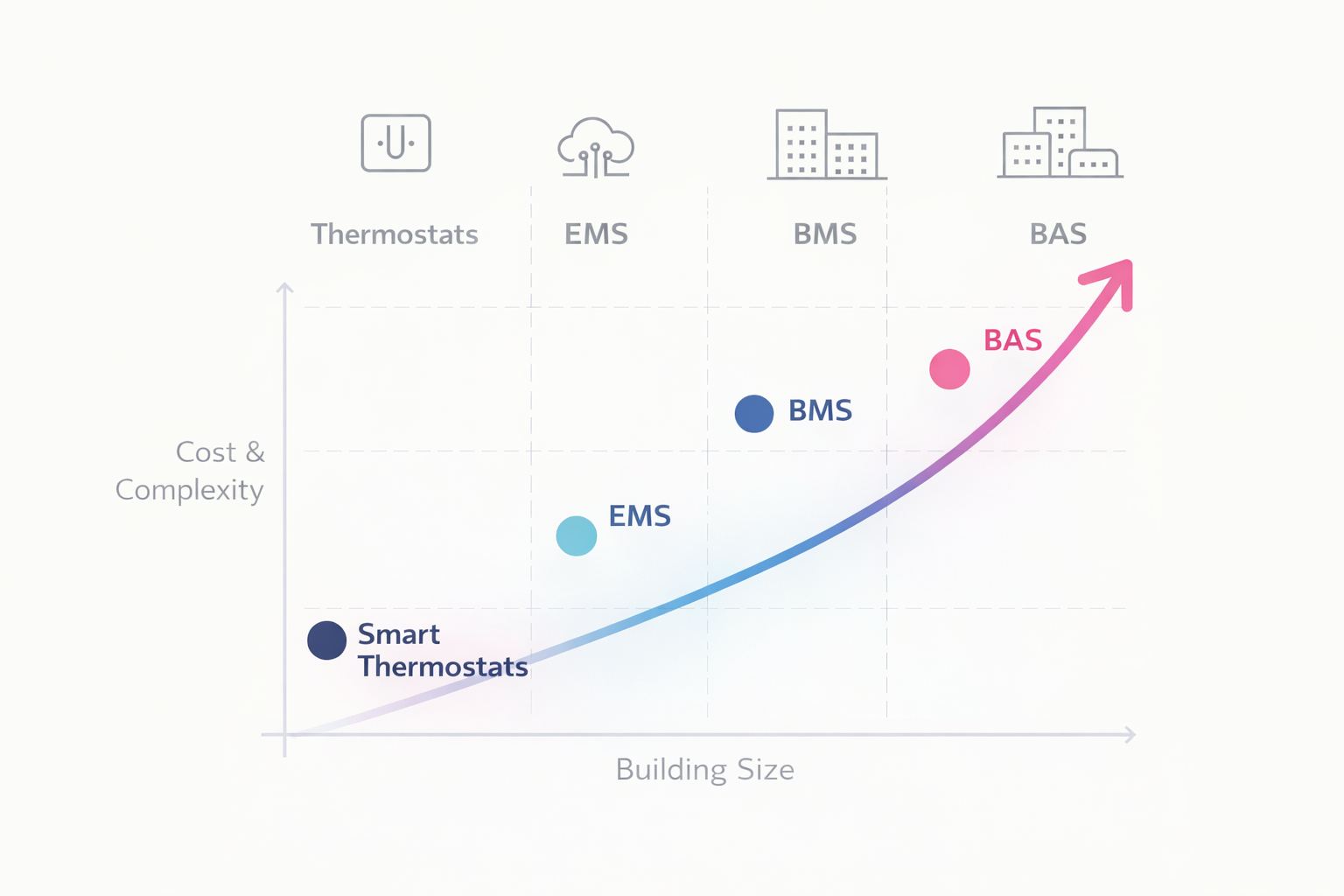
The Differences Explained: Smart Thermostats vs. EMS vs. BMS vs. BAS
Facility managers know the feeling: a unit that fails on the hottest day of the year, weekend emergency calls, aging equipment that “seems fine” until it isn’t. The truth is, most facilities don’t fail because of big problems—they fail because of small issues that go unseen.
For multi-site operators, these unseen issues multiply. Without unified visibility, each location becomes a silo—each with its own schedules, overrides, comfort complaints, and maintenance surprises. This is the core reason businesses are increasingly investing in smarter building technology, especially when energy costs, labor shortages, and reactive repairs are tightening margins.
Below is a clear breakdown of today’s building-management landscape—optimized for searchers asking “What is the difference between smart thermostats and EMS?” or “Why EMS is best for small commercial buildings?”.
Smart Thermostats
Smart thermostats are the starting point in the building technology hierarchy. Originally designed for residential homes, many smaller commercial spaces are adopting them due to their affordability and simplicity. Here’s a few things to consider before investing:
Pros
- Low cost per site (~$150–$500)
- Easy installation with consumer-grade hardware
- Good for single-zone or simple setups
- Useful for small, standalone locations
Cons
- Not scalable for portfolio visibility across 10+ locations
- Minimal equipment diagnostics
- Limited data for preventing breakdowns
- Not designed for multi-site operational consistency
This option provides a small commercial facility with a baseline level of control and visibility to help keep run-times on a schedule and be able to check in remotely. An entry-level option for local business owners looking to reduce energy consumption and keep watch for problems.
Energy Management Systems (EMS)
Definition: An EMS consists of hardware (like thermostats and sensors), which feeds into a cloud-based platform that monitors, analyzes, and optimizes HVAC and energy use across dozens to thousands of buildings. This provides centralized visibility and early issue detection commercial organizations need to maintain smooth facility operations across many locations.
Pros
- Best cost-to-value ratio (~$800–$1,500 per site annually)
- Portfolio-level oversight with alerts, trend data, permission-based access etc.
- Helps prevent emergencies by surfacing unseen issues before breakdown
- Installs in hours, not days, with your preferred mechanical contractors.Ideal for smaller footprint multi-site operators needing remote visibility and control
Cons
- Compatibility assessments are required across every location due to varying equipment
- Data is limited to HVAC (and occasionally lighting). More complex systems are not typically included
- Modern EMS solutions evolve quickly; many default EMS options installed by contractors, lack modern features due to slow hardware/software update cycles
This makes an EMS the right-sized solution for organizations that need meaningful insights without enterprise-level infrastructure costs. This often fits into facility sizes under 10,000 sq ft with low-complexity heating and cooling requirements like; retail, restaurants, convenience stores, and professional services.
Building Management Systems (BMS)
Definition: Building Management Systems (often used interchangeably with BAS, though historically distinct) offer broader control than an EMS. A BMS is a centralized control system for multiple building subsystems (HVAC, lighting, pumps, fuel), offering mid-level automation and monitoring for facilities desiring centralization of 3+ system types.
Pros
- Monitor and control HVAC, video surveillance, electrical systems, elevators etc. under a single system
- Integration for proprietary systems specific to your business is possible
- Good foundation for semi-automated operations
- Centralizes multi-faceted technical requirements across a property and solution types
Cons
- Higher installed cost (~$15,000–$50,000+ per site annually)
- Proprietary components & vendor lock-in
- Limited advanced analytics compared to modern cloud-native tools
- Overbuilt for smaller facilities
- Dedicated headcount(s) required to utilize full feature functionality
- Long contractual commitments to justify ROI
For large portfolios of sites, costs are high and must be deeply connected with revenue driving processes to justify the investment. Most portfolios consisting of <10,000 sq. ft. buildings, BMS systems are simply too complex and cost-heavy for the problems they solve.
Building Automation Systems (BAS)
Definition: A BAS is the most advanced, and expensive control system category, often designed for buildings of 50,000+ sq ft. It acts as the central nervous system for complex buildings, integrating HVAC, lighting, fire systems, security systems, occupancy sensors, alarms, and more.
Pros
- Remote monitoring and control of all systems in a building
- Full-system automation with advanced rules
- Strong long-term optimization potential
- Provides component-level monitoring across various critical assets
- Enterprise-grade fault detection and diagnostics (FDD)
- Integrates with other systems via API
Cons
- Very high installation cost (~$50,000–$250,000+ per site annually)
- Requires in-house specialized technicians to act on system insights
- Complex to maintain, upgrade, and troubleshoot
- Significant disruption during implementation
- Not viable for most small commercial buildings
A BAS can turn a large building into a semi-autonomous machine—ideal for campuses, hospitals, manufacturing facilities, or government infrastructure. These solutions are often required for buildings with complex needs, though less volume of locations.
For organizations with modest HVAC complexity, the cost-to-value ratio simply doesn’t make fiscal sense. Especially when the volume of locations is high.
The 10,000 sq. ft. Gap: Why Smaller Buildings Have Been Left Behind
Smaller facilities (which represent the largest market share of commercial businesses in North America, by a long-shot) historically lacked “right-sized” building management options. Smart thermostats are too simple; BMS/BAS too costly. A modern EMS hits the sweet spot, as it provides:
- Low deployment cost
- Cloud-based updates
- Fast ROI (within the same fiscal year)
- Built for multi-site portfolios
- Visibility required to catch small issues before they become emergencies
This is where the majority of commercial buildings finally gain access to meaningful control—without enterprise-level budgets.
A New Category: Right-Sized EMS for Small Commercial Buildings
Today, modern tools like Mysa HQ address the needs of buildings under 10,000 sq. ft. by offering:
- Centralized HVAC visibility
- Equipment health monitoring
- Portfolio-level scheduling
- Predictive alerts
- Easy deployment with no proprietary hardware and independent connectivity
- Pricing scaled for smaller buildings
This category fills the long-standing gap between smart thermostats and enterprise automation systems—giving facility managers meaningful control without enterprise-level cost and complexity of traditional BMS or BAS systems.
Which System Fits Your Facility Best?
Conclusion: Right-Sized Technology Reduces Stress, Emergencies, and Cost
Facility managers know the pain of emergency breakdowns, after-hours calls, and equipment that always fails at the worst possible moment. Choosing the right building technology can shift operations from reactive to proactive—saving time, money, and sanity.
Understanding the differences between smart thermostats, EMS, BMS, and BAS helps leaders select tools that match their building size, complexity, and budget.
Most importantly:
Small buildings finally have access to meaningful management technology.
The future of facility operations is simpler, smarter, and more accessible than ever—no engineering degree or enterprise budget required.
See a demo of Mysa HQ's lightweight EMS today >>

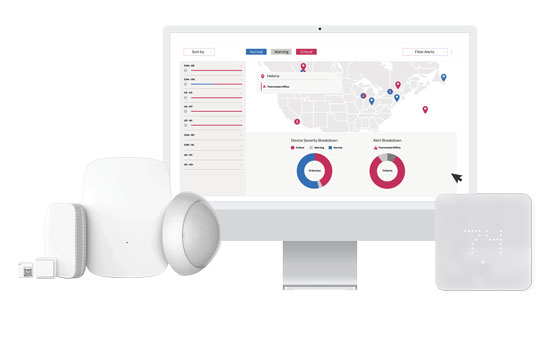

Ready to learn more?
See Mysa HQ in action, get a personalized ROI analysis, and start building the case for a smarter energy management system in your facilities.
